Introduction
Sourcing outdoor lighting controls for emerging markets isn’t as straightforward as pulling a model number from a catalogue. The same photocell that works reliably in a temperate North American climate can fail within months in the humidity of Malaysia, the dust and heat of Saudi Arabia, or the tropical wet seasons of Colombia.
Getting the specification right the first time saves a lot of expensive field replacements.
This guide is for buyers, distributors, and project integrators working across the Middle East, Southeast Asia, and Latin America, mapping regional luminaire types to the photocontrol specifications that those environments actually demand.
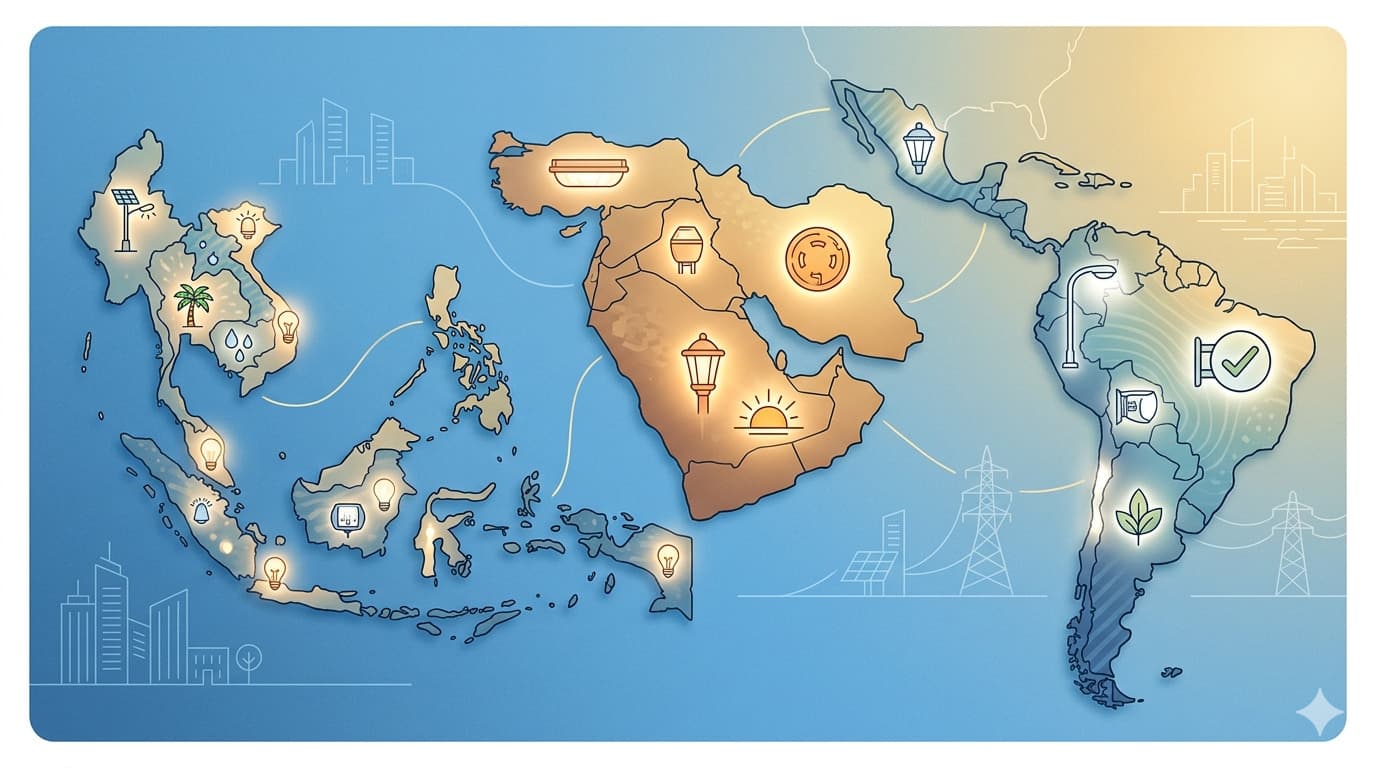
What Luminaire Types Are Common Across Each Region?
The luminaire mix across these three regions reflects different infrastructure priorities, and the photocell specification needs to match the fixture type and the environment it operates in.
Southeast Asia
Urban road lighting, residential pathway fixtures, wall-mounted area lights, and floodlights are the dominant types across Indonesia, Vietnam, Thailand, the Philippines, and Malaysia, with the common thread being high humidity and high average temperature across the full year.
Solar-powered street lights are widely deployed in rural and off-grid areas, particularly across island infrastructure. Commercial parks and industrial estates add higher-power area lighting to the mix.
Middle East
Dust protection is as important as waterproofing in this environment. High-mast roadway lighting, landscape and decorative fixtures, and large-scale public plaza lighting define most infrastructure projects in the Gulf states and wider region.
Smart city projects in Saudi Arabia, the UAE, and Qatar are increasingly specifying NEMA 7-pin receptacle systems that allow dimming control and remote monitoring alongside standard photocontrol switching.
Latin America
Street lighting, garden and pathway fixtures, floodlights for security applications, porch and residential lighting, and warehouse and industrial area lighting all feature prominently. Urban road upgrade projects in Brazil, Mexico, Colombia, and Chile are the primary procurement volume, alongside growing industrial park development driven by manufacturing investment.
What Does Each Region Require from a Photocontrol?
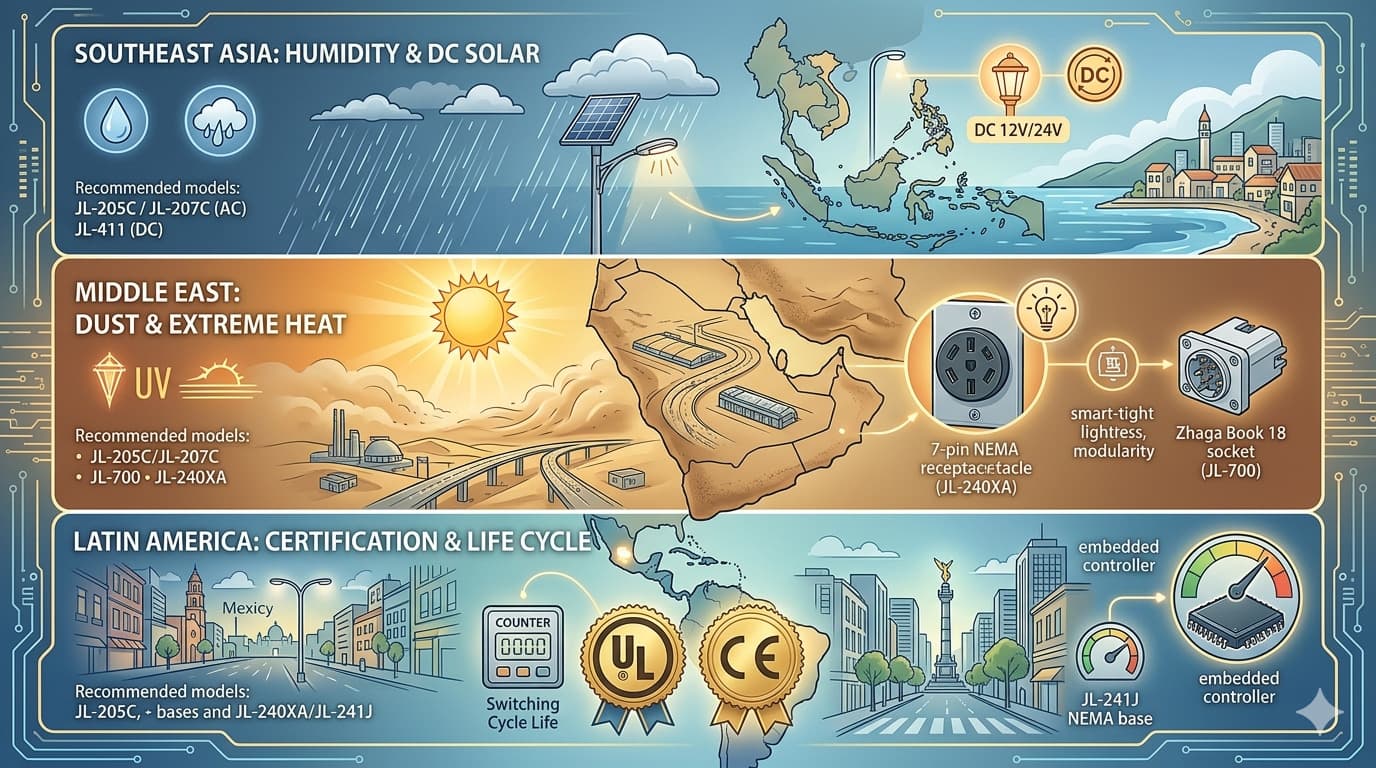
Regional environment and infrastructure type drive different photocontrol requirements, and treating all three markets as interchangeable leads to preventable specification errors.
Southeast Asia
High humidity and year-round heat are the dominant environmental pressures. IP65 is the minimum for any exposed outdoor installation, and IP67 is worth specifying for coastal and island locations. Solar-powered systems on 12V and 24V DC are common in rural deployments, requiring DC-compatible photocontrols rather than standard AC models.
Recommended models:
- JL-205C and JL-207C, for standard AC grid-tied street lighting
- JL-411 series handles 12V and 24V natively for DC solar systems
- JL-208 shorting cap and JL-240 receptacle base are useful accessories
Middle East
Dust protection matters as much as waterproofing here. A photocell rated only for water ingress will fail from dust accumulation in Saudi Arabia’s desert environment. Complete dust-tightness (the “6″ in IP65) is the baseline. NEMA receptacle-based photocontrols are strongly preferred for infrastructure projects because they allow tool-free replacement and straightforward smart lighting upgrades.
Recommended models:
- JL-205C and JL-207C for standard photocontrol applications
- JL-700 Zhaga series for luminaires with Zhaga Book 18 interfaces
- JL-200X 3-pin receptacle base for standard NEMA installations
- JL-240XA 7-pin NEMA base for smart lighting projects
Latin America
Buyers in this region consistently prioritise UL and CE certification, long switching cycle life, and energy efficiency. Municipal tenders in Brazil, Mexico, and Colombia increasingly specify minimum certification requirements that rule out uncertified products at the qualification stage.
Recommended models:
- JL-205C covers general street and residential lighting
- JL-200X receptacle base suits standard 3-pin NEMA installations
- JL-240XA 7-pin base enables smart lighting integration on infrastructure projects
- JL-241J NEMA interface base suits projects requiring embedded controller development.
|
Region |
Key Environmental Challenge |
Minimum IP |
Recommended Models |
| Southeast Asia | High humidity, DC solar systems | IP65 | JL-205C, JL-207C, JL-411 series |
| Middle East | Dust, extreme heat, UV intensity | IP65 | JL-205C, JL-207C, JL-200X, JL-240XA, JL-700 |
| Latin America | Certification compliance, long service life | IP65 | JL-205C, JL-207C, JL-200X, JL-240XA, JL-241J |
How Should Buyers Approach Pricing and Compliance in These Markets?
Long-Join photocontrols carry a price premium over the lowest-cost alternatives in some market segments, and the honest answer to that is: the premium reflects the certification, testing, and manufacturing quality that reduce long-term maintenance costs.
In price-sensitive markets, the temptation is to go with the cheapest unit that physically fits the fixture. For small residential projects, that calculation sometimes makes sense. For municipal roadway lighting, industrial parks, or any project with formal tender requirements, it usually doesn’t. The price of frequent maintenance visits at height could prove costly.
The most effective way to address price sensitivity without compromising the specification is through sample testing. Requesting samples before committing to volume allows buyers to verify IP rating performance, LED compatibility, and build quality against the actual project conditions. Long-Join supports sample evaluation for overseas buyers across all three regions.
What Are the Practical Steps for Getting the Selection Right?

Three steps consistently separate buyers who get outdoor photocontrol procurement right from those who end up with field failures and replacement costs.
1. Start from the regional application scenario and work backward to the specification
A solar DC street light in rural Vietnam needs a fundamentally different product than a NEMA twist-lock photocontrol for a smart highway project in Saudi Arabia. The fixture type, supply voltage, environmental exposure, and certification requirement together define the specification — the model number comes last, not first.
2. Use sample requests and field testing before volume commitment.
This is standard practice for experienced buyers across all three regions and the most reliable way to validate that a product will perform in the specific conditions of a project location.
3. Take advantage of Long-Join’s product breadth
The range covers standard twist-lock photocontrols, wire-in button photocells, smart NB-IoT controllers, Zhaga series, and NEMA receptacle accessories across 3-pin, 5-pin, and 7-pin configurations. Most project requirements across Southeast Asia, the Middle East, and Latin America can be served from within a single supplier relationship, which simplifies procurement logistics and spare parts planning.
Conclusion
Outdoor photocontrol procurement across the Middle East, Southeast Asia, and Latin America rewards buyers who understand regional requirements before selecting models.
- IP65 protection and UV resistance matter everywhere
- DC solar compatibility separates Southeast Asian rural deployments from grid-tied projects
- NEMA receptacle infrastructure dominates Middle Eastern smart city work
- UL and CE certification drive Latin American tender qualification.
Long-Join’s product range covers all three markets with models engineered for the actual demands of each environment. They are fully dedicated to enhancing product competitiveness and supporting customer market expansion
External Links
Post time: May-15-2026