Many specialized lights don’t run on grid supply, so how do their photocell sensors function in a low-voltage DC setup? Most photocell sensors on the market are designed for 120V or 277V AC systems. Drop one of those into a 12V DC solar street lighting structure, and you’ll have a problem on your hands pretty quickly.
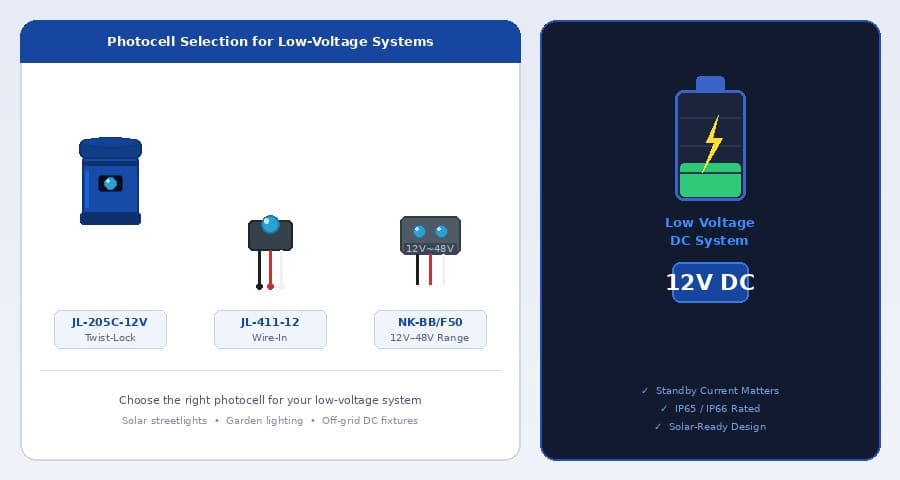
Scenarios like this are where 12V photocell sensors come in. They’re built specifically for low-voltage DC environments to help improve system intelligence and save energy. Picking the right one for your system takes a bit more thought than just matching the voltage. I will be taking you through what the JL-205C-12D and JL-411-12D bring to the table, how they compare against industry alternatives like the NK-BB/F50, and what to look out for when making your selection.
What Makes a 12V Photocell Different from Standard Models?
Why are 12V photocells made? A 12V photocell is engineered for direct-current low-voltage systems common in public space lighting, where both the operating voltage and standby current requirements differ significantly from those of AC-based outdoor lighting.
In a standard AC street lighting setup, the photocell draws from the main supply. However, in solar systems, the power comes from a battery charged by a panel, and every milliamp of standby current matters, especially in regions with limited sunshine hours or during cloudy periods when the battery is already under pressure. Good solar street light design accounts for extended cloudy periods in their battery capacity, which is exactly why low standby current in a photocell matters more in solar applications than in grid-tied ones. A photocell with poor standby efficiency can quietly drain a solar battery faster than expected, shortening the effective operating window for the light.
Beyond standby current, DC photocells also need to handle the specific load characteristics of LED drivers operating at low voltage, and they need to be reliable across a wide operating temperature range, since solar installations often go into remote or exposed locations such as solar streetlights, small garden lighting, and custom specialized lighting systems.
Overview of Long-Join 12V Photocells and Industry Products
Long-Join’s 12V photocell lineup covers two installation formats: twist-lock and wire-in, giving you a certified DC option regardless of your fixture’s configuration.
What Does the JL-205C-12D Offer?
The JL-205C-12D is Long-Join’s twist-lock phototransistor-based controller adapted for 12V DC systems, carrying the same core reliability as the standard JL-205C but built for low-voltage solar and garden lighting applications.
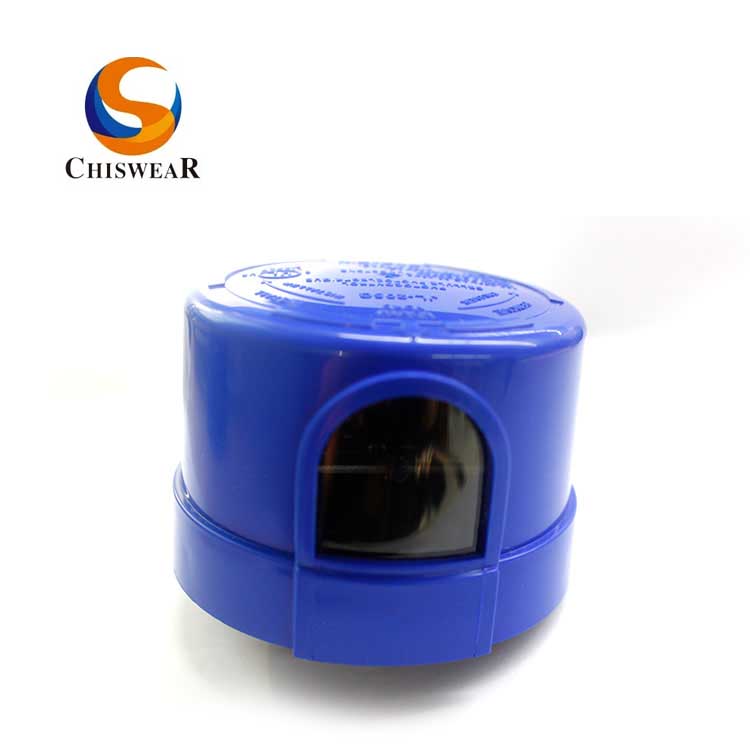
JL-205-12D/24D Twist Lock Photocell
The standard JL-205C has already proven itself, passing over 20,000 on/off cycles under UL773 testing with zero contact degradation across all five tested units. The 12V variant (JL-205-12D) inherits that build quality. It runs on a phototransistor sensing circuit with a 3–20 second built-in time delay, which stops the light from flickering off when a vehicle passes, or a cloud briefly crosses the sun. The twist-lock NEMA-compatible terminal design also makes installation and future maintenance straightforward. Visit Chiswear’s photocell product page to see the JL-205C and many viable twist-lock photocontrollers’ specifications.
What Does the JL-411-12D Add to the Picture?
The JL-411-12D is a wire-in DC photocell controller designed for 12V systems, with a compact split-type option that keeps the sensing head separate from the controller body, which is very useful where fixture aesthetics matter.
The JL-411 series takes a different installation approach compared to the twist-lock JL-205C. Its wire-in design suits fixtures where a NEMA receptacle isn’t available, and the split-type R version lets you position the sensing head independently from the main controller. This is particularly handy on solar garden lights or decorative pole fixtures where you want clean lines rather than a visible dome on top of the luminaire.
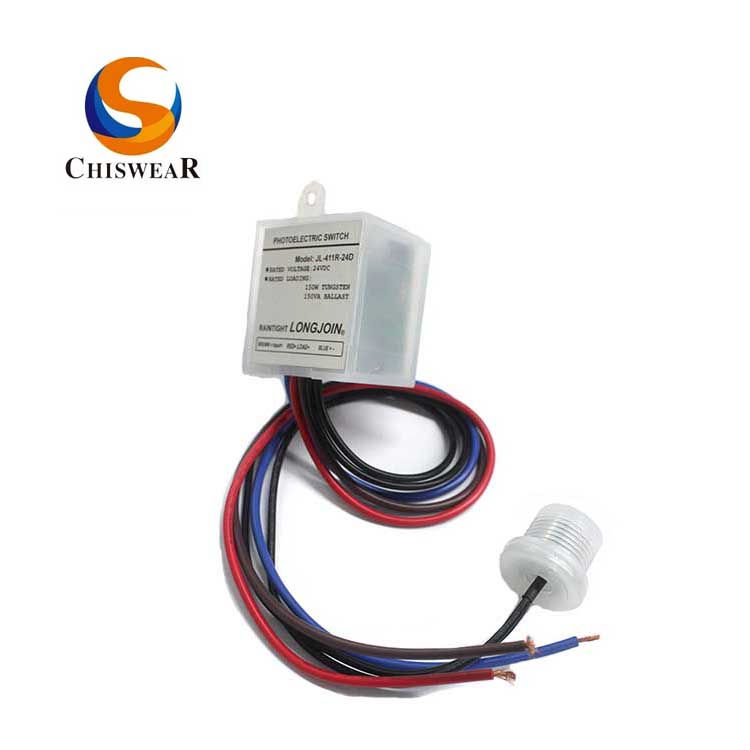
JL-411-12D /24D Wire-in Photocell
Standby current on the JL-411-12 is deliberately kept low, which makes it a better fit for off-grid battery-powered systems where consumption at rest genuinely affects how long the battery lasts through the night. The JL-411 is one of Chiswear’s reliable direct electronic wire-in controllers.
How Does the NK-BB/F50 Compare?
The NK-BB/F50 is a wide-range DC photocell covering 12V to 48V with a maximum output load of 3.5A, a standby current of just 0.3mA, and a switching range of 5–15 lux to turn on and 20–60 lux to turn off.
The NK-BB/F50′s voltage flexibility is its headline advantage. A single product that covers 12V, 24V, and 48V systems means fewer part numbers to manage across a mixed fleet of solar fixtures. Where the Long-Join products pull ahead is in certification depth, product track record, and the availability of application-specific variants. The JL-205C carries UL773 and ANSI C136.10 compliance, which matters for projects in North American markets or for buyers whose specifications require certified components. Long-Join also offers customization options on voltage, IP rating, and lead configuration, which is something harder to get from a standard off-the-shelf part. For a more detailed side-by-side breakdown, this comparative analysis of low-voltage photocell advantages over the NK-BB/F50 covers the technical differences in full.
Which 12V Photocell Should You Choose?
How do you select the right photocell for your solar lights? The right model depends on your fixture type, installation format, battery capacity, and whether your project requires certified components.
The table below lays out the key parameters side by side:
| Model | Voltage Range | Max Output Load | Light Switching Range | Standby Current | Connection Type | Best For |
| JL-205C-12D | 12V DC | Typical DC load | 10-20 lux on / 30-60 lux off | Low | Twist-lock | Solar streetlights and other low-voltage systems |
| JL-411-12D | 12V DC | Typical DC load | 5-15 lux on(Dusk) / 20-80 lux / off(Dawn) | Low | Three-wire | Low-voltage DC garden lighting |
| NK-BB/F50 | 12–48V DC | 3.5A | 5–15 lux on / 20–60 lux off | 0.3mA | Three-wire | Wide-voltage mixed fleets |
JL-205C-12D is the straightforward pick if your solar streetlight uses a standard NEMA receptacle and you need a certified, field-proven photocell sensor. But if your fixture is wire-in and aesthetics are a factor, the JL-411-12′s split-type design gives you more placement flexibility. And if you’re managing a mixed fleet running anywhere from 12V to 48V, the NK-BB/F50′s voltage range might justify its place in your inventory.
For OEM orders or projects needing custom lead lengths, IP ratings, or voltage configurations, Chiswear handles those requests directly.
Conclusion
Choosing a 12V photocell involves more than just matching voltage. Standby current, load compatibility, IP rating, connection type, and certification all feed into the decision.. The JL-205C-12D suits certified NEMA installations, the JL-411-12D works well where wire-in flexibility is needed, and the NK-BB/F50 earns its place in wide-voltage mixed-fleet applications. Match the spec to the system, not just the label.
External Links
- https://en.wikipedia.org/wiki/Solar_street_light
- https://www.buildings.com/architecture/article/55253895/best-practices-for-solar-street-lighting-systems
Post time: Apr-13-2026