Introduce
If you walk into a lighting maintenance facility and ask a field technician which photocell they prefer working with, the answer is almost always the fixed lux model.
This is not because adjustable lux doesn’t have its place, but because in the real world of outdoor lighting maintenance, adjustable lux creates problems that fixed lux simply doesn’t.
Both types detect ambient light and switch accordingly. The difference is who sets the threshold and when.
Fixed lux is set at the factory, verified through testing, and delivered ready to install. Adjustable lux hands that responsibility to whoever is on site with a screwdriver.
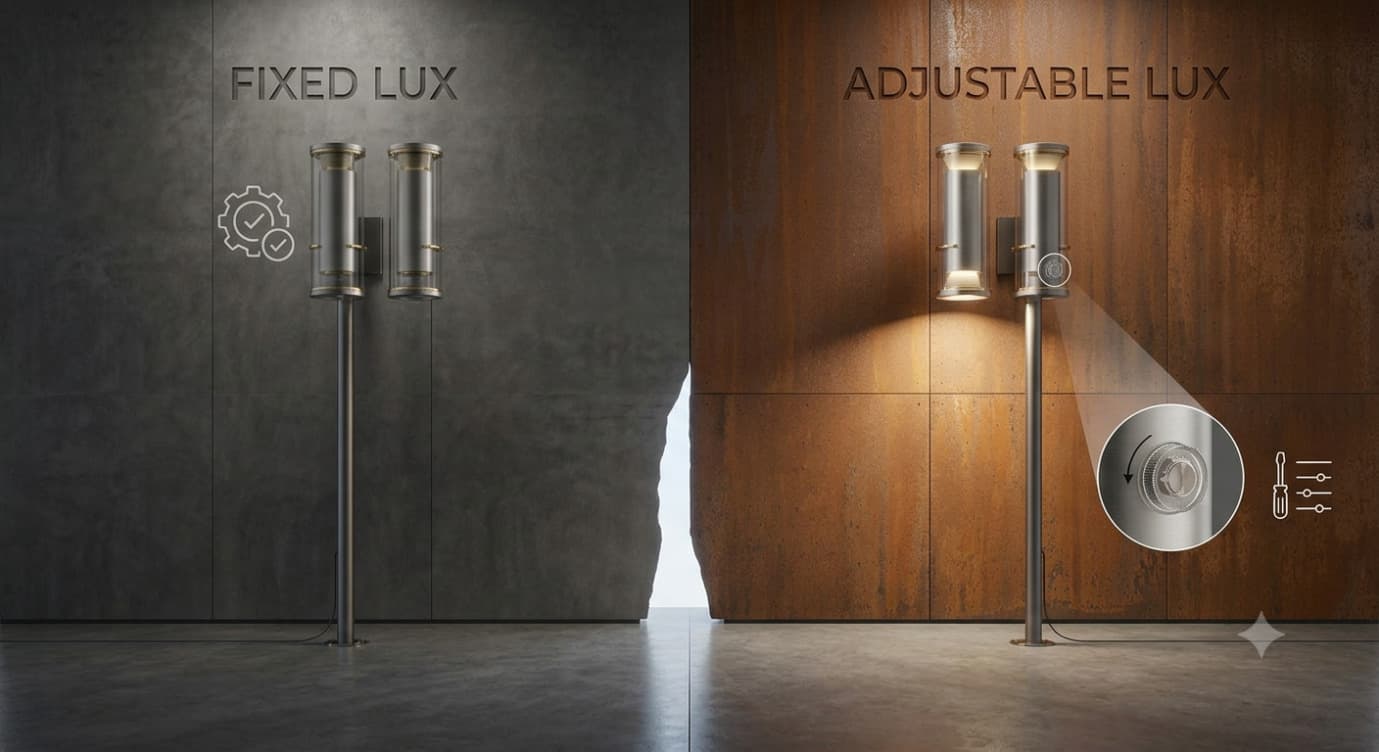
What Is the Difference Between Fixed and Adjustable Lux Photo Controls?
Fixed lux photo controls have the threshold preset at the factory and require no adjustment. Adjustable lux photo controls allow the switching threshold to be set on site via a dial or slide mechanism.
Fixed lux models remove the adjustment entirely. The factory sets the threshold based on the sensing component characteristics, tests it against defined performance standards, and ships a unit that will switch at the right lux level in the vast majority of outdoor installations without any site intervention. This is why they dominate commercial and municipal procurement.
Adjustable lux models offer flexibility for installations where the ambient light environment is genuinely unusual, such as deeply shaded positions, installations near strong artificial sources, or applications where seasonal daylight variation is extreme enough to require threshold compensation. In experienced hands with the right tools, that flexibility is useful.
What Are the Ten Reasons Users Consistently Prefer Fixed Lux?
Ten practical reasons explain why fixed lux photo controls outperform adjustable models across the most common outdoor lighting applications.
|
No. |
Reason |
Explanation |
| 2.1 | Avoidance of Human Error | Users often misadjust Lux, leading to faults like lighting during the day or failure to light at night |
| 2.2 | Immunity to Weather Changes | Stable thresholds prevent false actions caused by gloomy, rainy, snowy, or foggy conditions |
| 2.3 | Resistance to Seasonal Variation | Low winter sun angle reduces daytime illumination, causing users to mistakenly raise Lux; fixed thresholds do not drift seasonally |
| 2.4 | Immunity to LED Reflection Interference | Stable algorithms reduce sensing errors due to LED lamp reflective light |
| 2.5 | Suitable for High Mast Lights | High mast lighting has weaker illumination; fixed Lux prevents user over-adjustment that would keep lights off at night |
| 2.6 | Suitable for Harsh Environments | Performs reliably under high temperature, humidity, salt spray, rain, and snow conditions |
| 2.7 | Applicable to Road Lighting | Meets the continuous and stable control needed for road illumination |
| 2.8 | Suitable for Large-Scale Maintenance | Standard fixed values facilitate unified management and reduce operational risks |
| 2.9 | Suitable for Photodiode Photo Controls | Fixed Lux values combine effectively with photodiode sensors for better reliability |
| 2.10 | Suitable for Smart City Lighting | Provides stable, predictable control ideal for smart system integration and remote maintenance |
From these ten reasons, a clear pattern emerges. Most of them are about removing variability, either from human adjustment, weather, seasons, LED reflections, or environmental conditions.
Fixed lux doesn’t require the environment to be predictable, and it doesn’t require the person installing it to make the right call on a setting they may not fully understand.
For large-scale municipal networks specifically, reason 2.8 is often decisive. When a city is managing thousands of photocells across a network, unified fixed thresholds mean one standard, one spare part, one training requirement for maintenance teams. Every adjustable unit on the network is a potential out-of-spec installation waiting to generate a fault call.
When Does Adjustable Lux Still Make Sense?
Adjustable lux retains legitimate value in a small number of specific scenarios. Deeply shaded installations where the ambient light environment is consistently lower than the standard threshold would cause the light to switch on too early or never switch off. Specialty commercial applications where the visual environment is intentionally unusual. Research or testing installations where threshold variation is part of the measurement.
For everything else, such as street lighting, car parks, building facades, solar systems, high mast installations, smart city infrastructure, fixed lux is the simpler, more reliable, and less failure-prone choice.
Frequently Asked Questions on Fixed and Adjustable Lux
Q1: What is the main difference between fixed and adjustable lux photo controls?
Fixed lux models have the switching threshold set and verified at the factory. No site adjustment is needed or possible. Adjustable lux models include a dial or slide mechanism that allows the threshold to be changed on site.
Fixed lux suits the majority of standard outdoor applications. Adjustable lux suits specialist installations where the ambient environment genuinely requires a non-standard threshold.
Q2: Why is adjustable lux more prone to misoperation?
The adjustment requires understanding the relationship between the dial position and the resulting lux threshold, and making a correct judgement about what threshold suits the specific installation. In practice, many installers set the adjustment based on what looks right in the moment rather than what the photocell actually needs.
Q3: What advantages do fixed lux thresholds offer in winter and harsh weather?
Winter produces a low sun angle that reduces daytime ambient lux even in clear conditions, which can push a sensor reading toward the switch-on threshold earlier than expected. A user with an adjustable unit may compensate by raising the threshold, which then causes problems in other seasons.
Fixed thresholds stay constant regardless of seasonal variation; using the same factory-verified setting handles both summer and winter without any intervention.
Q4: How do fixed lux photo controls ensure proper lighting in high mast applications?
High mast fixtures are mounted at 15-25 metres, which means the illumination level at the sensor position is lower than at standard street light heights. An adjustable unit risks being over-adjusted by a technician who interprets the reduced illumination as a sign that the threshold needs raising, potentially setting a value that keeps the light off during periods when it should be on. A fixed threshold verified for the sensor’s actual operating conditions removes this risk entirely.
Q5: How do Long-Join photo controls maintain stability in smart city lighting?
Long-Join’s fixed lux models provide the predictable, consistent switching behaviour that smart city management platforms depend on. When a platform is monitoring thousands of fixtures and flagging anomalies, a photocell that switches at the expected threshold every day generates no alerts. One with a drifting or incorrectly adjusted threshold generates fault signals that require investigation.
Fixed factory-set thresholds across the JL-245CZ,JL-246CG and JL-245CN give smart city networks the stable baseline that remote monitoring and automated fault detection require.
@font-face{ font-family:”Times New Roman”; }@font-face{ font-family:”宋体”; }@font-face{ font-family:”Arial”; }p.MsoNormal{ mso-style-name:正文; mso-style-parent:”"; margin:0pt; margin-bottom:.0001pt; line-height:114%; font-family:Arial; font-size:11.0000pt; }h2{ mso-style-name:”标题 2″; mso-style-next:正文; margin-top:18.0000pt; margin-bottom:6.0000pt; page-break-after:avoid; mso-pagination:lines-together; line-height:114%; font-family:Arial; font-size:16.0000pt; }span.msoIns{ mso-style-type:export-only; mso-style-name:”"; text-decoration:underline; text-underline:single; color:blue; }span.msoDel{ mso-style-type:export-only; mso-style-name:”"; text-decoration:line-through; color:red; }div.Section0{page:Section0;}
External Links
Post time: Aug-12-2026