Introduction
Many people have the basic idea that a photocell is the thing that turns the street lights on at night. This insinuation is correct, but it skips the part that actually determines whether a photocell performs well or poorly in a given application.
The built-in sensor type is what sets performance apart. It considers factors such as sensitivity, response speed, interference resistance, and temperature stability.
This article breaks down the main sensor types used in photocells and explains what each one means for real-world outdoor lighting performance, using Long-Join’s JL-103A wire-in controller as the reference product.
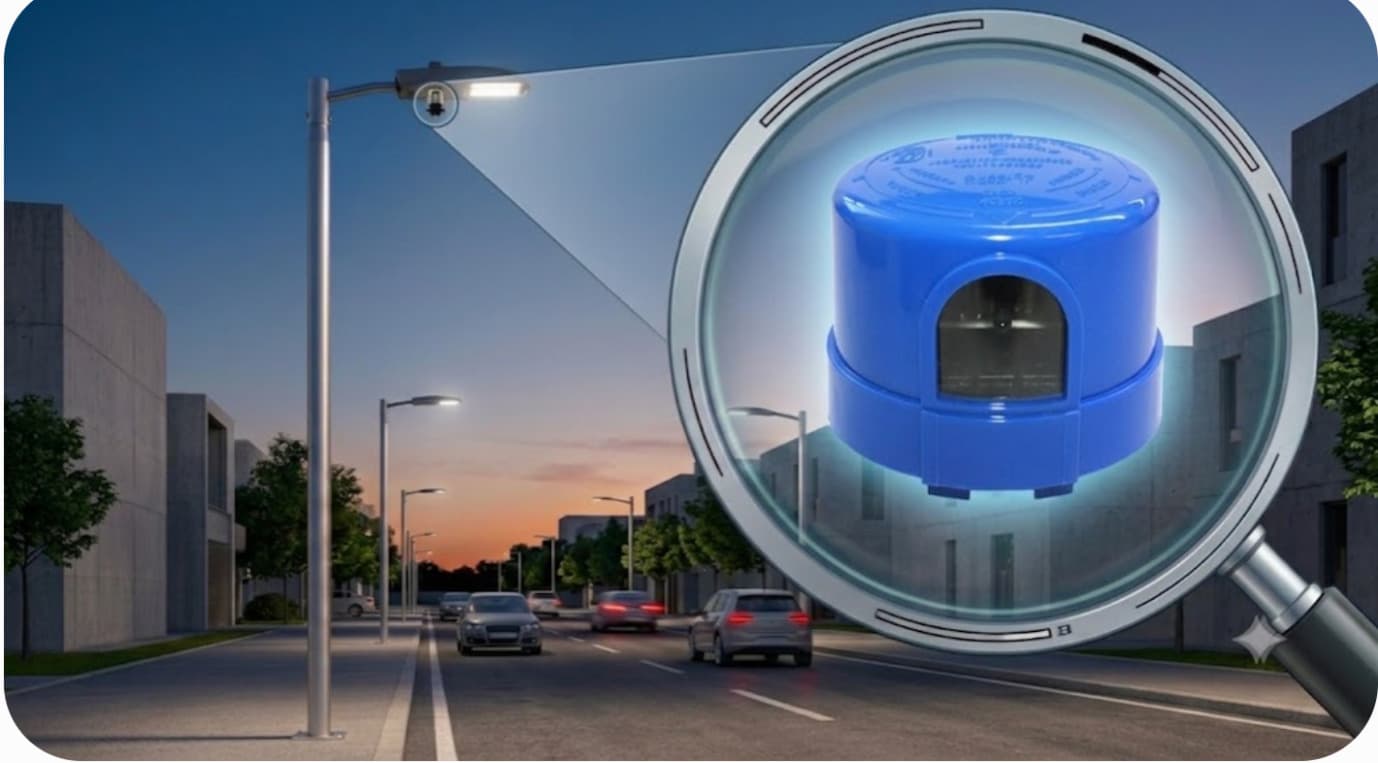
What Is a Photocell?
A photocell is an automatic switch that monitors the intensity of ambient light and switches a connected lighting load on or off when preset lux thresholds are exceeded.
When ambient lux drops below the on-threshold at dusk, the relay closes and the light switches on. When it rises above the off-threshold at dawn, the relay opens, and the light switches off. A built-in time delay of several seconds prevents the photocell from reacting to brief events like lightning or vehicle headlights that would otherwise trigger false switching.
Photocells are used across:
- street lamps
- garden lights
- security lighting
- commercial building exteriors
- other outdoor lighting applications where automatic dusk-to-dawn control is more practical than manual or timer-based switching.
What Are the Different Sensor Types Used in Photocells?
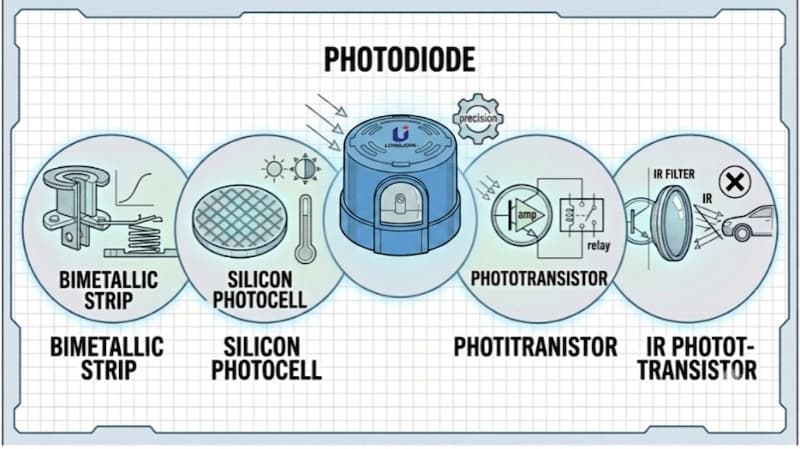
Five sensing technologies appear across the photocell market, each with different speed, accuracy, temperature stability, and interference characteristics that make it more or less suited to specific applications.
|
Sensor Type |
Features |
Typical Applications |
| Photodiode | Fast response, high sensitivity, low power consumption | High-precision ambient light detection |
| Phototransistor | Amplifies light signal, relatively high sensitivity | General-purpose photocells |
| IR Phototransistor | Detects invisible infrared, medium-short range sensing | Security systems, automatic doors |
| Silicon Photocell | Good stability, excellent temperature performance | Streetlight control |
| Bimetallic Strip | Temperature-triggered adjustment, mechanical structure | Early temperature/light combined control devices |
The photodiode responds fastest and consumes the least power, making it the right choice where precision and speed matter more than output signal strength. While the phototransistor amplifies the photoelectric signal internally, giving it higher output current and making it the most widely used type in general outdoor photocell applications.
The IR phototransistor adds an infrared filter that blocks the IR-heavy output of vehicle headlights and artificial sources, which is what the JL-207C uses to reduce false switching in highway and parking lot environments.
Silicon photocells offer excellent temperature stability across wide temperature ranges, which suits streetlight applications in climates with large seasonal temperature variation. Bimetallic strip sensors use a mechanical thermal element rather than a semiconductor, making them slower to respond but very durable in simple on/off applications.
Each sensor type determines the following for a photocell:
- sensitivity range
- response time
- how it handles interference from artificial light sources.
Choosing the wrong type for an application produces either false triggering, insufficient sensitivity, or switching threshold drift as temperature changes.
What Does the JL-103A Wire-In Controller Use and Offer?
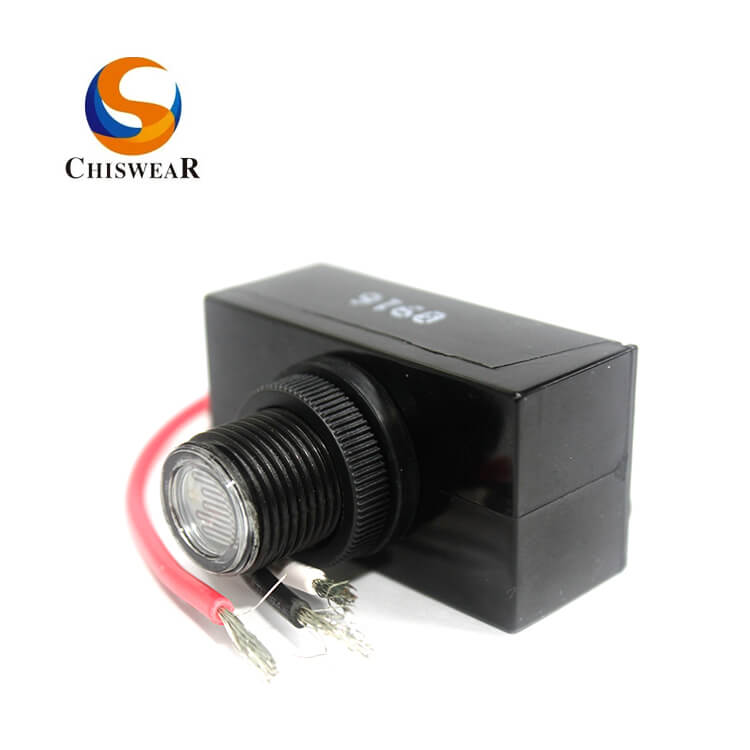
The JL-103A uses a high-performance phototransistor for stable, accurate light sensing across a wide range of outdoor applications, combined with a wire-in button format that suits most standard fixture types.
|
Item |
JL-103A Wire Type Controller Specifications |
| Rated Voltage | 120VAC |
| Rated Load | Supports up to 500W tungsten / 850VA ballast, compatible with various LED and efficient lamps |
| Sensor Type | High-performance phototransistor for stable light sensing |
| Wiring Methods | 2 or 3-wire system, simple installation |
| Lifespan | 10,000+ switching cycles |
| Protection Features | Overload protection, electromagnetic interference resistance, and short circuit protection |
The phototransistor in the JL-103A gives it better sensitivity and faster response than a bimetallic strip design, while the amplified output signal provides stable relay control without the additional circuitry that a photodiode-based design requires. Its UL773A listing covers non-industrial photoelectric switching applications, and its compact button format installs through a standard knockout hole in the fixture housing.
Where Are Photocells Used in Practice?
Photocell controllers appear across a wide range of outdoor applications where automatic light-level switching is more practical and efficient than manual or timer-based control.
The most common applications:
- Urban street lamps
- Commercial building lighting systems
- Smart home systems
- Solar lighting monitoring
What Are the Common Installation and Troubleshooting Points?
To find out if a specified photocell performs reliably across its rated service life, there are three factors to be considered:
- Installation position
- Wiring quality
- Environment
Install the sensor in an unobstructed position with sufficient natural sky exposure, ideally facing north, away from the fixture’s own light output and any reflective surfaces. Sensor shading from overhangs, trees, or nearby structures shifts the effective switching threshold and causes the light to come on too early or stay on too long.
Secure wiring and confirmed voltage compliance are equally important. The JL-103A’s built-in overload protection, EMI resistance, and short circuit protection handle the electrical stress factors, but the wiring connections themselves still need to be tight and sealed against moisture.
In harsh high-temperature or humid environments, the sensor’s operating temperature range needs to be verified against the installation conditions.
In Summary
A photocell’s performance is determined by the sensor inside it, not just the housing it sits in. Photodiodes offer speed and precision. Phototransistors provide stable amplified output for general outdoor switching. IR phototransistors add interference filtering for highway and parking environments. Silicon photocells deliver temperature stability for streetlight applications in variable climates.
The JL-103A’s high-performance phototransistor covers the broadest range of general outdoor applications with LED compatibility, built-in protection features, and a proven wire-in format that suits most standard fixture types.
Frequently Asked Questions on Photocells
Q1: What different types of sensors are built into photocells?
The five main types are photodiodes, phototransistors, IR phototransistors, silicon photocells, and bimetallic strips. Each has different speed, sensitivity, and interference characteristics suited to different applications.
Q2: What photosensitive device does the JL-103A use?
A high-performance phototransistor that provides accurate response to ambient light changes and stable relay switching performance across its rated operating conditions.
Q3: How does the sensor type affect a photocell’s performance?
It determines sensitivity range, response speed, temperature stability, and how well the sensor handles interference from artificial light sources. An IR-filtered phototransistor handles vehicle headlight interference that would cause a standard phototransistor to false-trigger.
Q4: What are common installation mistakes and solutions?
Insufficient sky exposure, sensor positioning near reflective surfaces, and loose wiring connections are the most common. Solutions are repositioning for clear sky exposure, orienting away from reflective sources, and confirming all wiring terminals are tight and sealed.
Q5: How can photocell misoperations be prevented?
Keep the sensor lens clean, install in a position with unobstructed natural light exposure, and minimise nearby artificial sources that could interfere with the ambient reading. For environments with persistent artificial light interference, specifying an IR-filtered model addresses the problem at the sensor level.
External Links
Post time: Jul-01-2026